Sam Eldin |
Automated Architect-Design and Data Centers for AI©
|
|---|
|
Our Projects Introduction: We as a team of AI and IT architects, designers, analysts, developers and managers has the goal of creating AI and software projects on paper. Our products are end-to-end system structure which includes analysis, architecting, designing, markups-prototypes, cybersecurity and virtual twin testing processes. We do not have a running system, but we provide all the needed system details starting with requirement, analysis, architecting, designing, security, data structure and DevOps and DataOps structure and processes. Our Twin Testing architect-design-processes would help development produce production code faster and accurate. We believe having projects on paper as a visual structure is the first step of cutting projects cost by more than 30%. It is easier and cost effective to apply changes to systems on paper. Integrations: Machine Learning, DevOps, DataOps, Cybersecurity, Twin Testing and Twin Management Integrations: These are the foundation structure and reusable subsystems which can be shared by any number of projects structure. They form a continuous, automated, and secure loop between the physical world and its digital counterpart. The integration is structured by their functional layers and containers-components so they can share data and work together as a unified system. Twin Management: This is the Coordination, Organization, Management and Planning. It manages the lifecycle, identity, and state synchronization of the digital twin. It ensures that the digital model exactly mirrors the physical asset's current physical configuration, software version, and historical state. Our Projects: 1. AI Tailored Virtual Butler Project 2. AI Virtual Receptionist Systems 3. Building Energy Self-Sufficiency AI Data Centers 4. Compression-Encryption Chip 5. Regenerative Medicine Umbrella 6. 3D Virtual Reality World Mall 7. Autonomous Vehicles 8. Intel Commercial Trucking Projects (ICTP) 9. Cryptocurrency Service #1. AI Tailored Virtual Butler Project Introduction: The global aging population is growing rapidly, with the U.S. population aged 65+ projected to reach 82 million by 2050. Alongside this growth comes a rise in cognitive decline, chronic health conditions, social isolation, scam victims and increasing caregiving shortages. Many older adults struggle not only with physical limitations, but with memory, decision-making, and maintaining independence in daily life. These challenges often lead to missed medications, unmanaged finances, reduced quality of life, and increased reliance on caregivers. 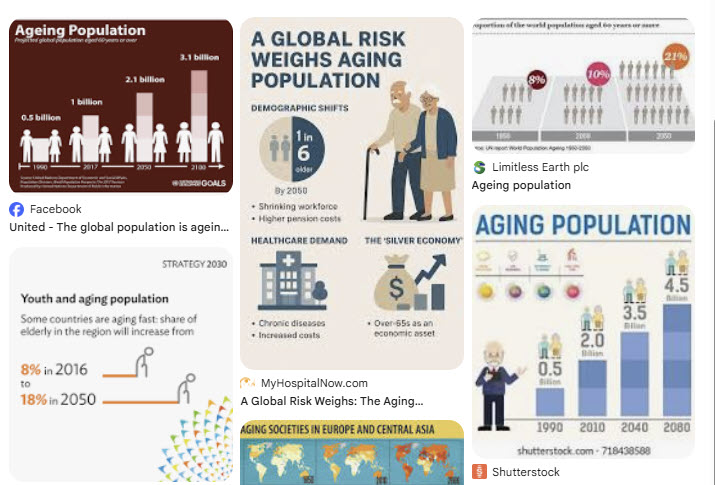
Aging Population's (Americans 65 and older) according to Google search The total cost of the aging population's (Americans 65 and older) health care and caregiving expenses is estimated to be $1.2 trillion in 2020, or roughly $22,356 per person. The Baby Boomers age 65 and older are expected to drive a $1 trillion-plus opportunity in consumer spending by 2030, with spending by those over 75 growing at double the national average. In 2026, the total population of adults aged 65 and older in the United States is approximately 62 to 66 million. This demographic accounts for nearly 18% to 19% of the nation's overall population, representing the largest sustained surge of aging Americans in U.S. history. Globally, there are approximately 850 to 860 million people aged 65 and older. This demographic accounts for roughly 10.5% of the total world population, reflecting a historic shift in human demographics due to increased life expectancy and declining fertility rates. These elderly are face chronic health conditions and cognitive decline such as: • Dementia • Alzheimer's disease • General age-related memory decline So, the problem is very real and the aging population is growing fast globally. For More Details see the following links: AI Virtual Butler Project Requirement AI Virtual Butler Project Architect-Design #2. AI Virtual Receptionist Systems Introduction: Our AI Virtual Receptionist Systems primary goal is developing our AI phone call service systems with a Virtual Receptionist Powered by AI. We are addressing a real-world problem which would automate tasks, integrate efficiency across industries, promote creativity, and empower groundbreaking advancements. Our main goal to use technologies and build a Virtual Receptionist system to work intelligently and independently. Our AI Virtual Receptionist Systems (Switch AI Model-Agent) simulates human-like intelligence in its answering services and performs tasks that typically require human intelligence and language understanding. Let us look at the different level of services which are addressed with our AI Virtual Receptionist Systems (Switch-Case AI Model-Agent): 1. Switchboard Operator 2. Secretary 3. Receptionist 4. Answering Services 5. Customer Service 6. Technical Support 7. Sales Generation 8. Questions and Answers 9. Trainer 10. Call Center 11. Customer Retention 12. Customer Retaining 13. Customer Preservation 14. Customer Maintenance 15. Ordering Service Processing 16. Appointment Scheduling 17. Booking Appointments 18. Gate Call Box 19. Unique Customer call experience What Are We Selling? Our answer is addressing all these listed issues. 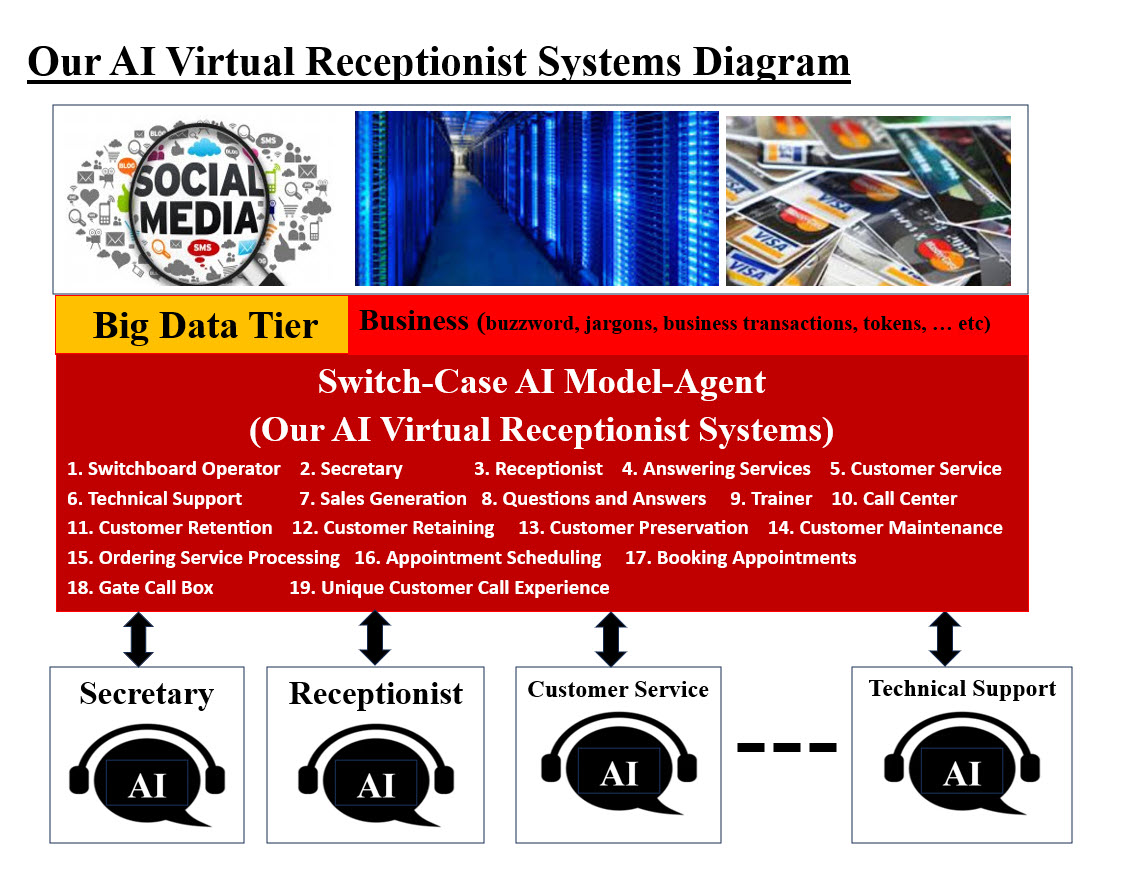
Our AI Virtual Receptionist Systems Diagram Image Our AI Virtual Receptionist Systems Diagram Image presents a rough picture of our Switch-Case AI Model-Agent (Our AI Virtual Receptionist Systems). In a nutshell, our system analyzes Big Data and uses the business's buzzword, jargons, business transactions, tokens, ... etc. to prepare all the required data and processes for each of the 19 different level of services. Each of these 19 services would be performing its unique AI Virtual receptionist rule. The key ingredient in our AI agent is our Machine Learning (ML) system and tools. Our approach is not training AI with data, but analyzing, parsing data and preparing all possible scenarios, errors, situations, miscellaneous, ... etc. Plus using the speed of the computer system to handle volume, variation and miscellaneous. For example, Google search is considered the most accurate search engine due to its advanced algorithms and vast database. Google's BigQuery is a cloud-based data that's designed to handle large amounts of data. It's serverless, so there's no infrastructure to manage. Our ML system and tools are using AI to match if not to exceeds Google BigQuery. We are introducing our Switch-Case algorithm and AI Agent which is far more intelligent, structured, modular and faster upgrade of any existing AI Decision Tree algorithms, agent and tools. For More Details see the following links: Switch-Case AI Model-Agent (Our AI Virtual Receptionist Systems) Sam Eldin’s Switch-Case Algorithm Sam Eldin’s Switch-Case AI Model-Agent (Our AI Virtual Receptionist Systems) #3. Building Energy Self-Sufficiency AI Data Centers Introduction: AI Data Center's average energy consumption is estimated to be in the hundreds of million and growing. The center's cooling system consumes over 40% of power consumption. The staffing and experts needed are hard to get. AI is the future systems and the businesses' competitive edge. AI system development is complicated plus data handling, Machine Learning, AI Model and AI Agent are big on promises and short on delivering. Brief Description of Our AI Data and Development Centers Project(s): Developing AI Data and Development Centers is a major undertaking with emphasis on AI thinking, hardware, software, energy consumption, management, environment issues and governments involvement. It is also a very expensive project. Therefore, we may not have the right answers to some of the issues, but we are addressing them. Brief Description of Our AI Data and Development Centers Project(s): Developing AI Data and Development Centers is a major undertaking with emphasis on AI thinking, hardware, software, energy consumption, management, environment issues and governments involvement. It is also a very expensive project. Therefore, we may not have the right answers to some of the issues, but we are addressing them. Building The Future of AI Data Centers and Development Centers: Issues: 1. Global energy investment is projected to reach $3.3 trillion 2. In 2024, global data centers consumed about 415TWh, representing roughly 1.5% of global electricity demand 3. Data center energy use is projected to nearly double to 945TWh by 2030 (3% of global electricity) International Energy Agency (IEA). 4. According to Forbes, citing the IEA, reports that global energy investment is projected to reach $3.3 trillion in 2025. Our Answers to AI Data and Development Centers and Their Energy Consumption: Our quick answer to addressing that AI Data Centers consumed about 415TWh, representing roughly 1.5% of global electricity demand and its demands is on the raise, by simply building the following: • Restructuring of AI Data and Development Centers • Optimizing the Centers' Processes: • Machine Learning + AI + Cybersecurity + DevOps • Big Data Machine Learning Analysis • Building AI Model-Agent Foundation for Businesses and Research Institutions • Data Streaming Using Compression-Encryption • Building Energy Self-Sufficiency AI Data and AI Development Centers Our Restructuring of AI Data and Development Centers: We are focusing on addressing the current issues with AI Data and Development Centers by restructuring AI Data and Development Centers. The following is our main steps of Restructuring: 1. Vertical = Issues with each unit or component 2. Horizontal = The Number of Units as they are spread horizontally across the Glob 3. Optimum Size 4. Specialization 5. Automation Using Robots The Cost: We are restructuring and redesigning literally everything within these Centers and that comes with a price. For automation, open racking systems with motherboards (for more details see next sections) and replacing staff and human support with Robots. This is a new cost and it's Return on The Investment is definitely worth it. For example, using of Robots to run the entire center including repairs and effectively clean the dust off the equipment which have not been done before and also have an initial cost. Locations: Looking at the world map image, we placed some red circles indicating the target locations to build our AI Data and Development Centers. Our target areas should be hot-sunny costal areas. 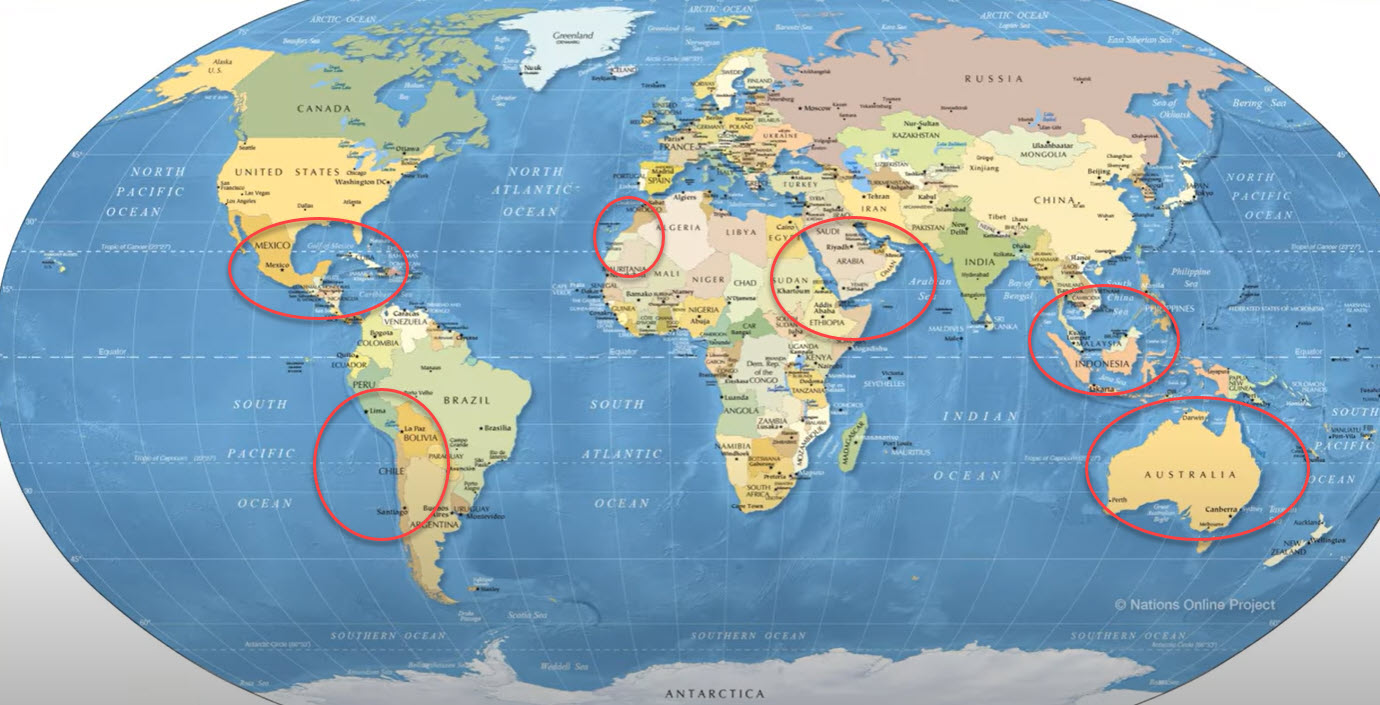
World Map The following is a list of countries, and their location in the World Map: Egypt, Saudi Arabia, Gulf Countries, Yamen, Eretria, Somal, Sudan, Oman, Morocco, Chili,Mexico, Puerto Rico, Costo Rica, Australia, Philippine Plus we are open to other locations. For More Details see the following links: AI Business Plan AI Business Plan Videos' Scripts #4. Compression-Encryption Chip Introduction: The internet is highways of data traveling from one computer network to another computer network. Data is packaged in small amounts of data known as Packets. There are rules and regulations governing the processes of moving these packets. A router receives and sends data on computer networks. Packets traveling through such routes would have to pass through each of the networks. There is nothing that can stop any of the routing networks from having a copy of each packet, damage the packets or stop the packets from going to next network. What we just described are some of the possible cyber security issues. As for privacy, both hackers and companies can use such data in these packets to their advantage. For example, mobile data can be accessed by other Apps running on the same mobile device. Lossless Compression: Reduces file size by eliminating redundancies without losing any original information. What are we proposing? First, a packet is composed of a data section and network traveling information sections. The connecting networks only use the network traveling information sections to get the packet to the next routed network. The data section should not change nor be altered. We are proposing the building of a computer chip which compresses-encrypts the packet data section. What is special about our Compression-Encryption Chip? Compression and encryption are not new and have been used in packet security. Based on the type of data, both compression and encryption would slow down the system quite considerably. The main goal is to handle packets as fast as routers. Our Lossless Compression-Encryption Algorithms: First, we need to state that our audience needs to accept our claims without any proof - we are protecting our trade secrets: • Our lossless compression-encryption algorithms are as fast as any CPU with zero loss of data. • We are not presenting any hint or proof so we do not give our algorithms away. • The world is full of gurus and any hint may give our secrets away. • Our algorithms must run on a sperate chip. • The chip must have its own CPU and memory (Cache and core). A Data Compression Ratio: A data compression ratio is the mathematical comparison between the size of original (uncompressed) data and the size of the compressed output. What is the highest Lossless data compression ratio in world today 2026? Reducing mixed data corpora down to roughly 17% to 19% of their original size, or a ~5:1 to 6:1 ratio. Our Lossless Data Compression Ratio: Our Lossless Data Compression Ratio of 10:1 means that every 10 bytes of original, uncompressed data has been reduced down to 1 byte of compressed data. In other words, a file with a size of 100 megabytes would be compressed to 10 megabytes plus the compression speed is as fast the CPU speed. Only catch is our lossless compression must run on its own chip with CPU, Cache and main memory. 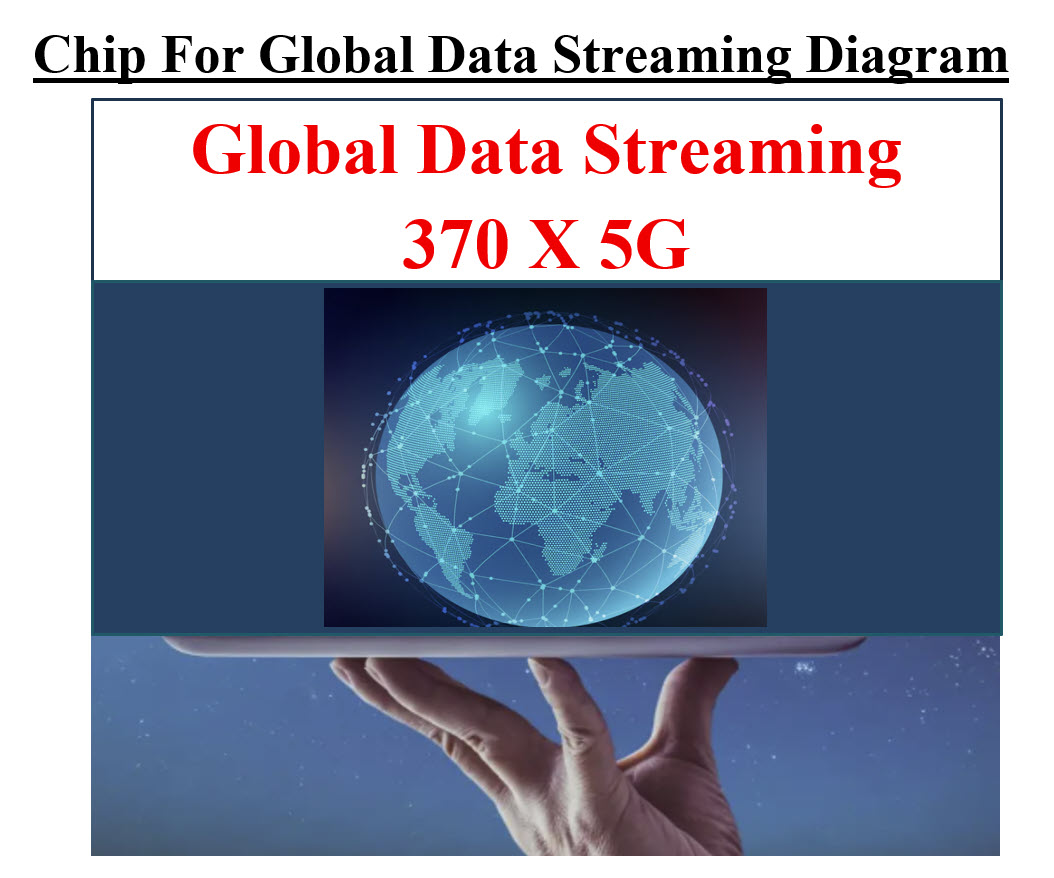
Image - Chip For Global Data Streaming Diagram Data Compression Speed and Size: Our Answer to World Data Compression-Encryption Speed, Size and Saving: We believe our lossless compression ratio is 10:1 or 90%. In other words, a file with a size of 100 megabytes would be compressed to 10 megabytes plus the compression speed is as fast the CPU speed. Only catch is our lossless compression must run on its own chip with CPU, Cache and main memory. To calculate the actual saving we need to present Network Nodes. What is a node in networking? A node in networking is any physical device or virtual component connected to a network that can create, receive, store, or transmit information. A network node is any physical device or virtual component connected to a computer or telecommunications network that can create, receive, store, process, or send data. What is the average number of nodes on a network? Internet Packet Hops (Router Nodes): When a data packet travels across the global internet, it typically passes through an average median of 5 to 20 router hops (nodes), though some paths can stretch to 30 or more depending on distance and architecture, according to user discussions on. If we take average numbers of network node = 5 We are saving 90% of the data size using our chip compression. Then the total saving at 5 Network nodes = 5 * 90% is equals to 450 of data steaming boosting. Of course, there is other things which are running at the same time (delays) and that why we are proposing 370 * 5G as showing in the Chip For Global Data Streaming Diagram image. The Saving and Target Clients: We used Google search to answer the following questions: What is YouTube's total storage size and cost for 2026? YouTube's total storage size is estimated to be between 10 to 15 exabytes (10-15 billion gigabytes), but Google does not publicly disclose the exact total storage size or its specific infrastructure cost. 2026 Capital Expenditures (CapEx): Meta's official guidance for full-year 2026 capital spending sits between $130 billion and $145 billion. This is roughly double the $72.2 billion spent in 2025. What is Facebook's total storage size and cost for 2026? Total Expenses: Meta projects total expenses between $165 billion and $169 billion for 2026. The company notes that the overwhelming majority of this growth is driven by infrastructure costs-which include data center hardware, rising storage component and memory pricing, third-party cloud agreements, and depreciation. Data Compression Speed and Size: According to Google's search: Data compression always trades processing speed for smaller file size. The Trade-Off Triangle: • Compression Speed: How fast an algorithm shrinks the data. Fast speeds are needed when writing data quickly to a disk or network. • Decompression Speed: How fast the algorithm restores the original data. Fast speeds are needed when reading data frequently. • Compression Ratio (Size): How small the final data becomes compared to the original size. Higher ratios mean smaller files but require more CPU power. Our Answer to World Data Compression Speed, Size and Saving: We believe our lossless compression ratio is 10:1 or 90%. In other words, a file with a size of 100 megabytes would be compressed to 10 megabytes plus the compression speed is as fast the CPU speed. Only catch is our lossless compression must run on its own chip with CPU, Cache and main memory. YouTube, Facebook with storage demands would be able to turn all the data to 10% of what they have running right now. They would have 90% of their current data storage free to add to them. Is 10:1 lossless compression-encryption ratio a gamechanger for internet? And how? Our Lossless Compression-Encryption is a Gamechanger: We believe our lossless compression-encryption running on its own chip (with CPU, Cache and core memory) is a gamechanger for internet and would be used as a part of cybersecurity and DevOps-DataOps. Recommend to our audience as Google, ChatGPT, GitHub and any of the big AI vendors the following questions: Is 10:1 lossless compression-encryption ratio a gamechanger for internet? And how? What would be the performance of 10:1 lossless compression-encryption ratio, running on its own Chip (with CPU. Cache and core memory). Boosting cybersecurity and DevOps-DataOps So they can see the answers themselves. For More Details see the following links: Compression-Encryption Cyber Security Chip #5. Regenerative Medicine Umbrella Introduction: What is Regenerative Medicine and what are we trying to accomplish? In a nutshell, Regenerative Medicine is a new field with the focus on developing and applying new treatments to heal tissues and organs and restore function lost due to diseases, damages, defects or aging. We believe the following are the top major Regenerative Medicine associated fields:
As End-2-End architects-managers-visionaries-entrepreneurs, we are interested in leading Regenerative Medicine efforts and help take Regenerative Medicine into a different level. Therefore, our attempt in this page is to present the page topics with the goal of keeping Regenerative Medicine medical professionals and Information Technologies (IT) professionals on the same page. Creativity Without Resources nor Support: Our audience must understand that what we are presenting in this page is: Our Architect-Design (Our System on Paper) and we do not have a Running Product Our Regenerative Medicine Umbrella is what we envision the future of Regenerative Medicine would be. The goal is helping all Regenerative Medicine associated fields team up for the good of all. This page represents how we translated our vision into a documented architect-design without any resources nor support. With the right resources and support, we can make our architect-design a successful and a rewardable reality. United States Government Accountability Office (GAO) Report: United States Government Accountability Office (GAO) Report to Congressional Committees on July 2023 on the: TECHNOLOGY ASSESSMENT Regenerative Medicine Therapeutic Applications, Challenges, and Policy Options What GAO found: Regenerative medicine offers the hope of being able to restore or replace cell, tissue, and organ functions affected by disease, injury, or aging. This may eventually help manage or cure many conditions that are currently considered chronic, untreatable, or terminal. GAO identified many challenges that may affect the development and use of regenerative medicine technologies and therapies including: • Challenges related to standardization • Challenges related to regulation • Challenges related to manufacturing How big is the regenerative medicine market in 2022? The global regenerative medicine market size was estimated at USD 55.04 billion in 2022 and is expected to reach USD 65.08 billion in 2023. Our Answer to GAO: 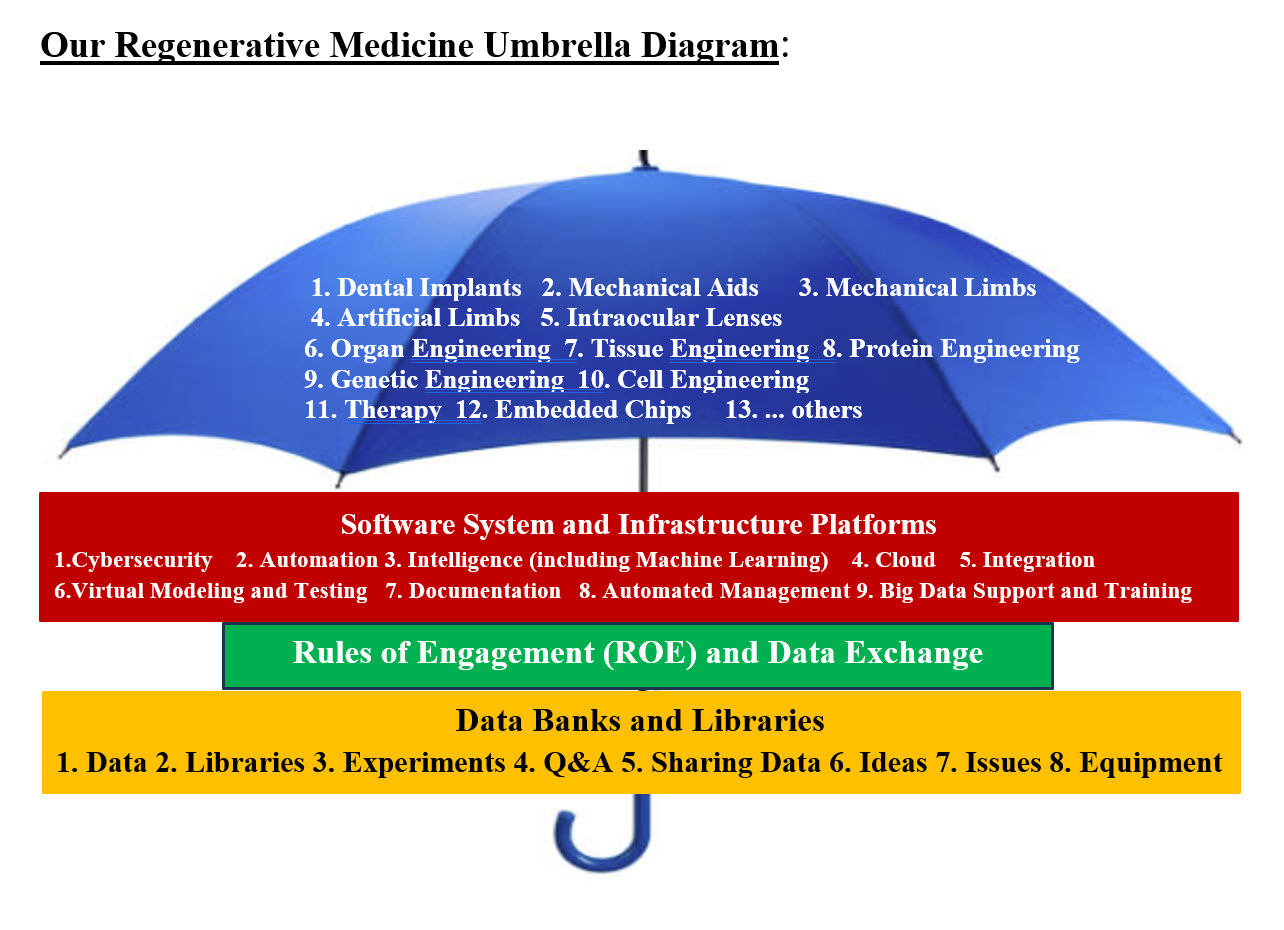
Image - Regenerative Medicine Umbrella Diagram Regenerative Medicine Umbrella Diagram Image represents our vision of Our Regenerative Medicine Umbrella components. Each of the Regenerative Medicine associated field or a group of associated fields can develop their own unique Software System and Infrastructure Platform. These platforms would be serviced by Data Banks and Libraries with the help of Rules of Engagement (ROE) and Data Exchange Services. All their cooperative efforts would: 1. Eliminate working-in-vacuum to save effort and time 2. Help one another in advancing their work and achieving their goals 3. Save the repeated efforts and errors 4. Share documentation, publications, experiment and equipment 6. Use the Rules of Engagement (ROE) and Data Exchange Services to cooperate 7. Protect each pattens, copyrights, data, resources and trade names 9. Save efforts, resources and funds 9. Set the future cooperative roads and exchanges For More Details see the following links: Our Regenerative Medicine Umbrella #6. 3D Virtual Reality World Mall Introduction: Coming Soon #7. Autonomous Vehicles Introduction: Case Study - Autonomous Vehicles Introduction: This page is our Case Studies of Autonomous Vehicles (AV) and it is also part of our Virtual Edge Computing with Machine Learning as a replacement of Edge Computing Boxes-System. Based on whom you talk to, AV is either a total success or another failure. Our answer is: so far, we do see plenty of electric cars on the roads, but hardly we see Autonomous Vehicles (AV) driving on roads with no driver on broad. Therefore, success or failure is not part of this page's goals. Letter to The Department of Defense (DoD) and The Air Force is Our Main Target: Our Autonomous Vehicle (AV) analysis and architect is an intelligent Virtual Automated Integrated System which would be the seed for something bigger such as Autonomous Fighter Jets, Tanks and other DoD hardware. What we are presenting is not a trial and error system as most AV vendors are running into, but our AV is true system which addresses all the hardware (bare-metal) and software. By searching the internet, sadly most AV vendors' claims seem to be more marketing since we do not see any mass production of their AV running on the roads for the world to use. Compression-Encryption System: Part of our Cybersecurity architects, tools and approaches and products would be using our Compression-Encryption System. Our Compression-Encryption System in a game changer in data streaming, Compression-Encryption and Cybersecurity. Our Focus: Our focus is using virtualization, intelligence, automation, cloud, Cybersecurity, integration, Machine Learning and DevOps and DataOps to structure an intelligent dynamic robust solution to Autonomous Vehicles. As for Hardware, our DevOps is our only focus and not the AV mechanical parts nor AV's sensors. We view them as data sources. Main Issues and Our Goals: Our AV page is to present issues and goals and not to debate on AV issues. We would look at any AV as we would be looking at cloud networks and Data Centers. The main issue of AV is that AV is a dynamic system with continuous generation of non-structured terabytes of data which we would need to store, analyze, process, and use to make decisions and give choices. Our Goals in this page are covering the following: • Analysis and View - See Something Through a Different Lens • Components and Machine Learning • Structure • Interfaces Communication • Data • Intelligence • Security • Processes • Machine Learning • Management • Possible Solutions • Autonomous View • Using Computer Models and Virtual Testing Analysis and View - See Something Through a Different Lens: We recommend that the readers check the following pages as quick references to our first part of AV's analysis. Electric Vehicles© Virtual Edge Computing with Machine Learning© Our AV case study is based on electric vehicle and our Case Study - Electric Vehicles (using 2022 Tesla Model Y as our electric vehicle Case Study) is our starting analysis of our AV case study. Views (See Something Through a Different Lens): Einstein demonstrated to us in the early twentieth century that if we look at anything through a different lens, what we perceive will be different. The following are how we would be viewing the same thing: • Closed Box View • Virtual Container and Virtual Components View • Autonomous Vehicle Components' Functionalities View • Interfaces View • Data Flow View • Processes View • Time View • Cloud View • Security View • Machine Learning View • Using Computer Models and Virtual Testing Closed Box View: 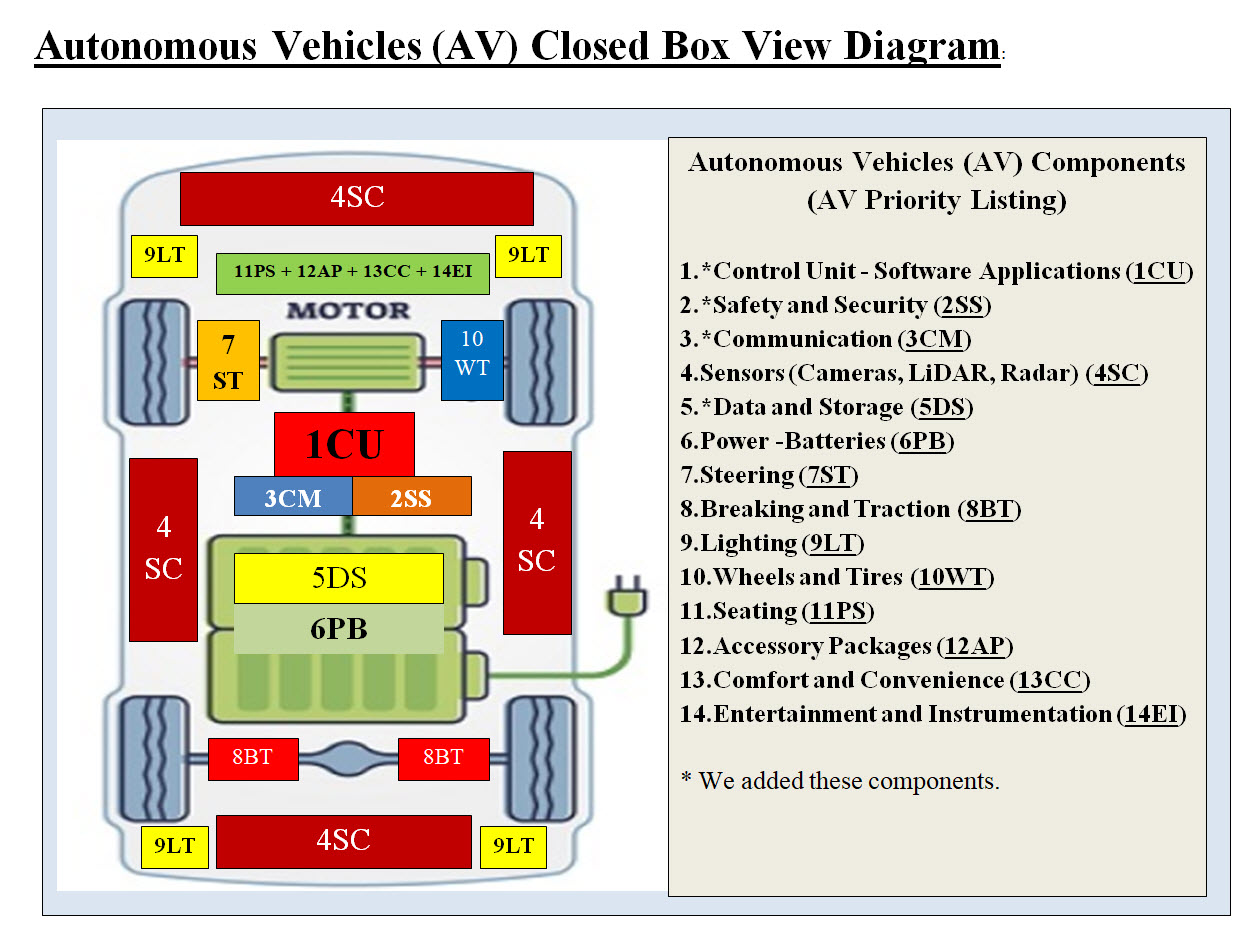
Image #1 Image #1 is our Closed Box View, which means we would be looking at each item within the image as a closed box with no details. Based on our research of most popular AV and our Electric Car Case Study (2022 Tesla Model Y features Car Features), we came up with the components in Image #1 as closed boxes. We used Tesla car features s part of our analysis. We set their priorities, names and locations as we see them. We also added other boxes such as Control Unit - Software Applications (1CU), Safety and Security (2SS), Communication (3CM) and Data and Storage (5DS). We renamed them according to their ranking priorities and name abbreviation. For example: 1CU = priority #1 and name is "Control Unit which is composed of Software applications" 5DS = priority #5 and name is "Data and Storage" We believe "Closed Box Approach" makes it easier for people to see the overall picture without any overwhelming details. As for AV sensors "Sensors (Cameras, LiDAR, Radar) (4SC)" and their locations, we placed them within one closed box type (4SC). There are more than one 4SC boxes. As for the feature 11 though 14, we boxed them together since their priorities is lower than other features. * is an indication that such a component or closed box is our addition and not necessary AV component. For More Details see the following links: Case Study - Autonomous Vehicles #8. Intel Commercial Trucking Projects (ICTP) Executive Summary We are proposing an intelligent, futuristic and cloud approach which would use automation and intelligent system to advance the business and create a new futuristic commercial trucking components. These components would include all the major players as well as training drivers. The key ingredient is speeding and automating the overall commercial trucking processes. Our approach would eliminate all the repetitive tasks and the focus would be performance.
What we mentioned so far is an abstract and the actual reality can be illustrated by the following example. We need to mention the fact that shopping would eventually move to the mobile-internet and delivering goods would boost substantially. All the package and mail ground delivery carriers can cut their cost in term of dollars and time by more than 60%. They would be using our intelligent, automated, cloud, distributed system sharing Data and National Trucking Hubs. We would use automation for transport between National Trucking Hubs and local drivers for deliveries. In short "Over the Road Trucking" would be replaced by automation and truck drivers will keep their jobs doing local deliveries. Our intelligent system would help carriers handle the load increase, speed deliveries and cut the operating cost. Automation would be working for the trucking business not replacing it. Building our intelligent automated system does not require big capital, but needs total cooperation of all big players in the commercial trucking business including federal and states governments. In term of time, with proper resources, management and planning, it can be a reality in less than one year. For More Details see the following links: Intel Commercial Trucking Projects (ICTP) #9. Cryptocurrency Service Introduction: What Are Cryptocurrencies? Searching the internet, we found the following definitions: Cryptocurrency is a form of currency that exists only in digital form. Cryptocurrency can be used to purchase online without going through a mediator, such as a bank, or it can be held as an investment. Buying cryptocurrency doesn't grant you ownership over anything except the token itself. It is more like exchanging one form of currency for another. If the crypto loses its value, you would not receive anything for it. 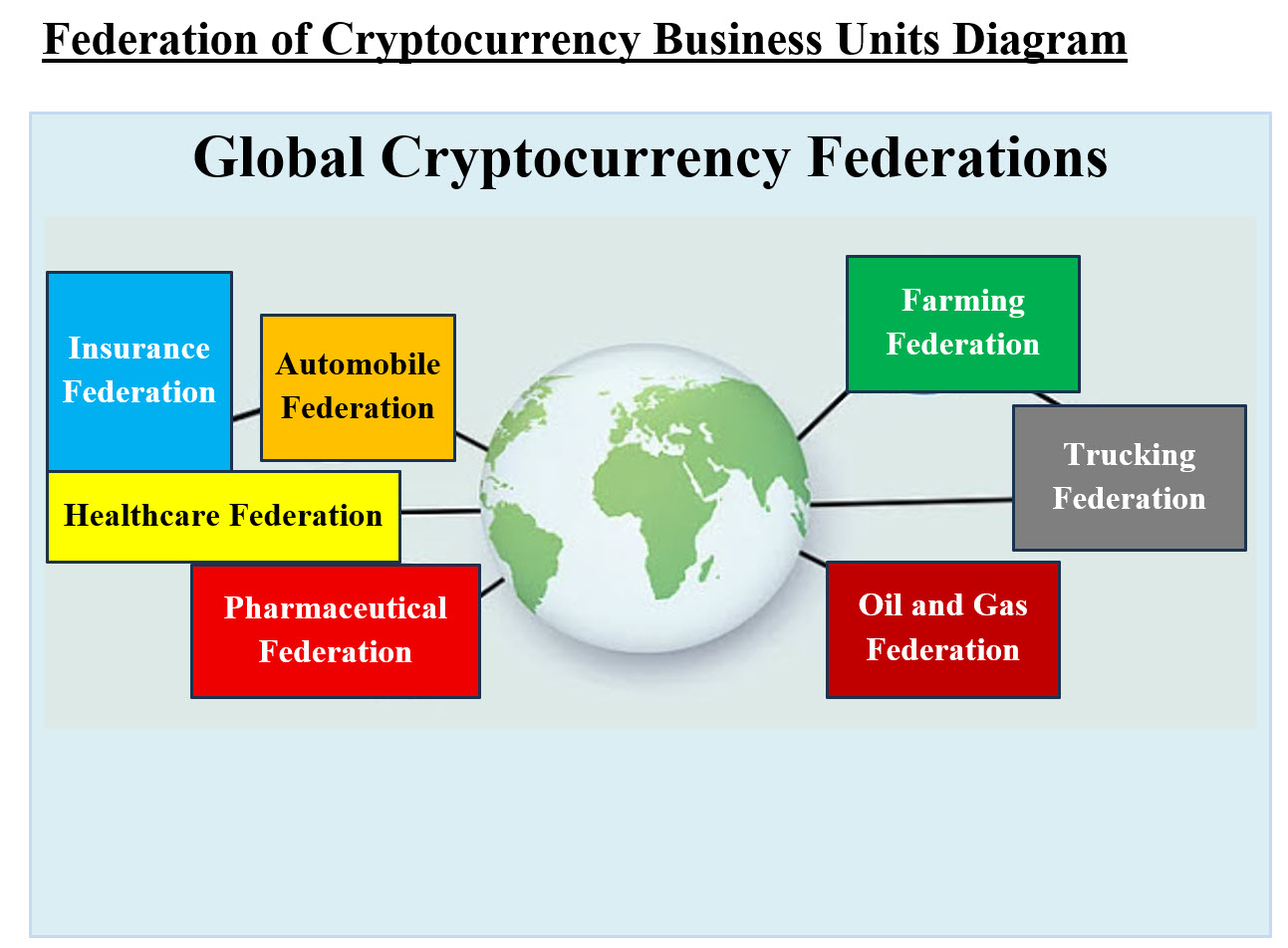
Image Federation of Cryptocurrency Business Units Diagram Federation of Cryptocurrency Business Units Diagram Image presents a rough picture of a number of possible Cryptocurrency Federations. Each Business Federation would be structured to be independent and self-serving. Currently, we are proposing the following federations: 1. Insurance 2. Automobile 3. Healthcare 4. Pharmaceutical 6. Farming 7. Trucking 8. Oil and Gas Cryptocurrency Business Units Cryptocurrency business units and organizations typically group their operations into specialized functional sectors based on infrastructure, trading, and services. Cryptocurrency Federation: Groups that function as collective bodies advocating for policy, self-regulation, or public education. Structuring and Securing Cryptocurrency: We are rewriting this page with the hope of not being too technical for our nontechnical audience. The Goal: Our Goal is to make Cryptocurrency services as good as the banking services if not better. We need to set up some basic understanding of what we mean by Structuring and Security Cryptocurrency as a Business. What does it mean to structure a business? We believe that structuring a business is planning, organizing, configuring and building the foundation for the business to run and grow. The foundation or the infrastructure is the base that business is built on. Such business foundation needs constant monitoring and maintenance. What does it mean to secure a business? When it comes to securing Cryptocurrency, we need to address a number of issues starting with Cryptocurrency monetary value, transactions, Cybersecurity, banking, exchange, investment, ..etc. Cryptocurrency is a digital currency and when it comes to the monetary value of a currency, we need to look at USA Dollar. With US Dollars, anyone can go to any country and would be able to use US Dollars to pay for goods and services, exchange or even deposit in banks. The US Dollars are backed up by US Government and US business finance. Therefore, our security goal is to build a monetary system compatible to the US Dollar. Our Target Audience or Clients: • Cryptocurrency Companies • Cryptocurrency Plateforms • Cryptocurrency Dealers • Cryptocurrency Exchange • Cryptocurrency Broker • Banks • Investors Our Project Presents: 1.0 Cryptocurrency Foundation or Structure 1.1 Cryptocurrency Federation - Governing Body 1.2 Business Unit Federation of Cryptocurrency 1.3 The Federation of Cryptocurrency Companies 1.4 Cryptocurrency-Coin Clusters of Companies 1.5 Structuring and Tracking Cryptocurrency (Holder - Coin) 2.0 Our Service - What are we selling? - Our architects and tools 2.1 Securing Cryptocurrency Transactions 2.2 Using Virtualization 2.3 Proxy and Rerouting Servers and Distributed Cloud Plus Alerts 2.4 Our Vertical and Horizontal Security Architect 2.5 Integrating our Structure and Tools into any Existing System 2.6 Virtual Testing 2.7 Building Machine Learning Tools as Background Support 3.0 Security 3.1 Securing Cryptocurrency as Buisness 3.2 Securing Cryptocurrency Processing 3.2 Securing Cryptocurrency Future 3.4 Securing Cryptocurrency Growth 4.0 Transactions 4.1 Cryptocurrency Services 4.2 Cryptocurrency Transactions 4.3 Cryptocurrency Banks 4.4 Cryptocurrency Exchange 5.0 Models 5.1 Computer Models 5.2 Virtual Testing of Computer Models 6.0 Implementation 6.1 Cryptocurrency City 6.2 Cryptocurrency Business Unit 6.3 Cryptocurrency Franchise For More Details see the following links: Sam's Cryptocurrency Service #10. Oil and Gas Refinery Introduction: Our Case Studies - Oil and Gas Refinery is a part of our Virtual Edge Computing with Machine Learning. Our main goal is to present our Virtual Edge Computing with Machine Learning System as a replacement of Edge Computing Boxes-System. We believe Edge Computing Boxes-System is an overkill, an added layer(s) and an overhead in security, maintenance, performance, cost, ..etc. Letter to The Department of Defense (DoD) and The US Navy is Our Main Target: Our Black Box: Our Black Box is an Edge Computing Boxes-System with built-in small size bare-metal servers. Each bare-metal server runs independently. Our Black Box is an Edge Computing Boxes-System analysis and architect is an intelligent Automated Integrated System which would be the seed for something bigger such as mentoring system which would be placed on facilities, sites, ships, ports, camps, ..etc. Such system would be the global eyes and ears of commend centers with real-time tracking and control. The Case at Hand (We Have a Different Animal): After our researching and analysis of Oil and Gas Refinery, our Oil and Gas Refinery Case Study needs to take a totally different approach. In short, we do have a major case which would impact the world economy. According to market research by IBIS World, a leading business intelligence firm, the total revenues for the oil and gas drilling sector came to approximately $2.1 trillion in 2021. Department of Homeland Security (DHS) calls the energy sector one of the most powerful engines of the American economy. The consequences of any destructive attack (cyber or not) on oil and gas resources would have significant financial losses for the private sector to potential physical and economic impacts on all the world municipalities. A major attack would trigger gasoline and diesel price spikes, panic buying, and supply shortages across the world. Vulnerability of Oil and Gas Infrastructure: The size of any Oil and Gas Infrastructure can be seen from space. For example, Oil Tankers, pipelines, Oil Rigs in the middle of ocean, storage facilities and some modern petroleum refineries process as much as 1.2 million barrels of crude oil per day, cannot be missed. The exhaust coming out of these refineries can be seen from miles. In short, almost all of Oil and Gas Infrastructures are vulnerable for assaults, cyber attack, drones attacks, sabotage plus the consequences can be devastating. On September 14, 2019, two major Saudi Oil Installations were hit by Drone Strikes and the attacks immediately escalated tensions in the Persian Gulf amid a standoff between the United States and Iran. The monstrous cyber attack on Saudi Aramco, one of the world's largest oil companies. The assault was the most alarming in a string of hacking attacks on petrochemical plants in Saudi Arabia. In a matter of hours, 35,000 computers were partially wiped or totally destroyed. Our Goal: Our goal is providing the analysis-architect-design as a security solution for Oil and Gas Refinery using our Virtual Edge Computing with Machine Learning. Since "We Have a Different Animal" plus the Vulnerability of the Gas Refinery, our analysis-architect-design would require different approach than our analysis-architect-design for cloud system, Data Center, Autonomous Vehicles or networks. We need to see how the military such as the navy and how the US Navy would handle their approach of securing their troops, tankers, ships, equipments, hardware, ..etc. How Can These Oil and Gas Infrastructures Be Secured? What are we dealing with? Security for Oil and Gas Infrastructure takes on a totally different meaning from what we have been developing for cloud system, Data Center, Autonomous Vehicles or networks. Oil and Gas Infrastructure is an open fields of buildings, pipes, trucks, Equipments, supertankers, Oil Rig middle of ocean, storage facilities, computer system, financial payment system, tracking system, plus at this point in analysis and architecting we are new to this field and we do not have the entire picture. The following is very much what we believe we need to cover: Data (Paperless) Trail, Updates and System Image - Black Box: Issues at Hands: We believe the real issues at hand is how to prevent any interruption of service since any interruption may have deadly consequences or economic disasters. Energy is the center of our daily life and interruptions of energy have disastrous consequences. For example, all the major hospitals with hundreds of thousands of patients and operations, cannot offered interruptions in their energy supplies. Our Concerns and Questions: These are some of our concerns and questions, but what we are presenting is the start of a long list: • How to secure the continuation Oil and Gas operations? • How to monitor personnel, procedures, equipment, computer systems, weather and outsiders? • How to prevent human negligence or errors from taking place? • How to reinstall computer system in case of cyber attack where all system were wiped clean? • How to reinstall data system in case of Ransomware where accessing data is permanently blocked? • How to monitor and protect pipelines from attacks or Sabotage? • ... etc. Black Box Concept: The Black Box, technically known as Flight Data Recorder, is an instrument that records all the activities of aircraft during its flight. Black Box is designed to survive any crash and with its valuable data. Our Black Box: Our Black Box is an Edge Computing Boxes-System with built-in small size bare-metal servers. Each bare-metal server runs independently. We had named each bare-metal a "Service Unit". Each has its own power-battery supply. Paperless Trail: It is accustomed in modern businesses to have paper trail as solid record keeping for tracking. In our case, we do have a Magnetic or Laser Trail of records, where the trail is either magnetic (saved on disk) or laser (saved on CD). Our Paperless trail is used as a permanent recordkeeping. Read-Only Data or System Images: To prevent damaging data or system images or overwrite them, we are proposing Read-Only devices as a part of the Edge Computing Boxes (servers). Our Approach: 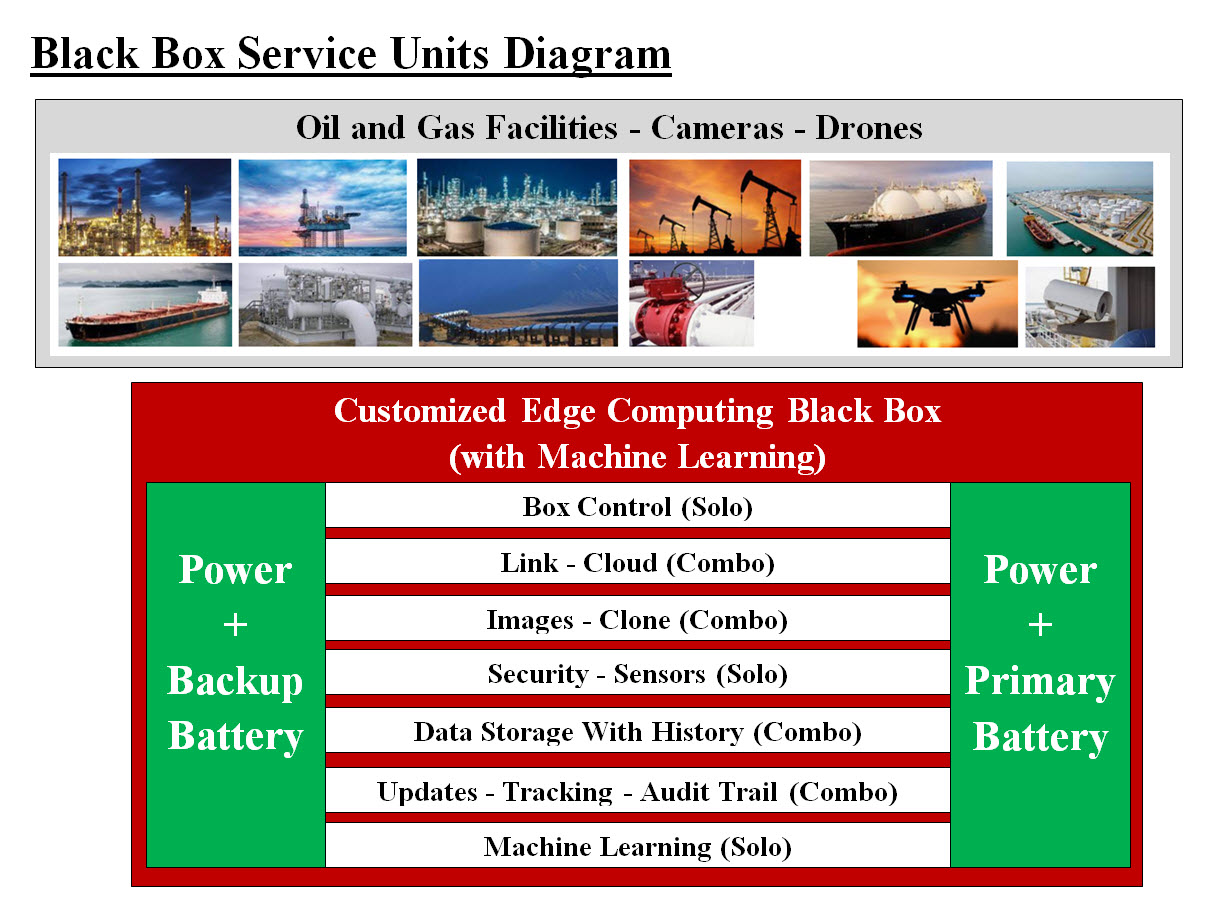
Image #2 Our approach is to create Edge Computing Box with the following capabilities: 1. Intelligent 2. Secured 3. Outside 4. Physically Protected 5. Closed 6. Layered 7. Component-Based 8. Self-Starter 9. Integrate-able 10. Independent 11. Cloud 12. Remotely Controlled 13. Energy Efficient 14. Track-able 15. Machine Learning Tools Image #2 presents a customized Edge Computing Boxes-System to be used by the Oil and Gas facilities. Each Edge Computing Box would have a set of "Service Units " (Bare-Metal Servers) based on the needed functionalities and services. For More Details see the following links: Case Study - Oil and Gas Refinery |
|---|